
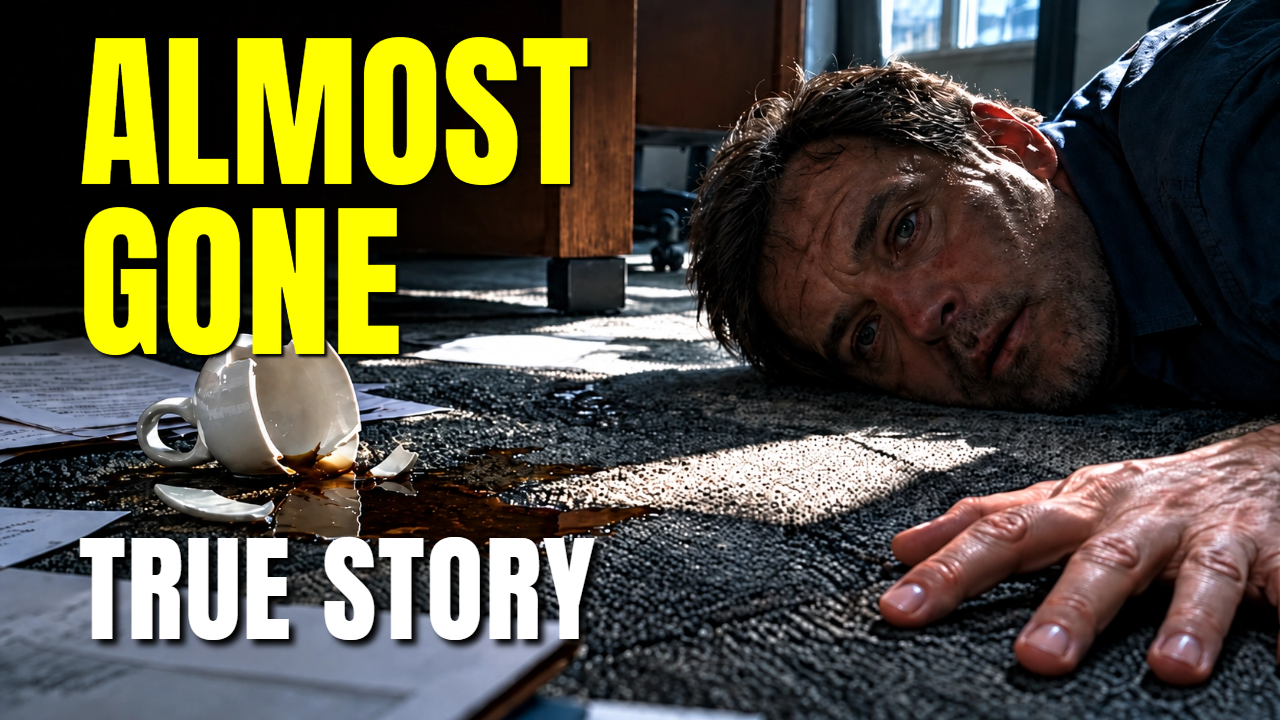
I can still hear the sound my knees made when they hit the floor of my office. Half past two on a Tuesday afternoon, an ordinary day in an ordinary life, and then nothing about it was ordinary at all.
Today I am a heart attack survivor, but that is not the part of this story that still visits me at night. Lying there, I could not breathe and I could not speak, and I was not thinking about my wife. I was not thinking about my daughter. I was not thinking about the mortgage, the overtime, or any of the bills I had spent years so carefully paying.
There was a single word in my head instead. Only one. It was not a word I would have chosen for a moment like that, and it had not arrived that afternoon. I had been using it for years, quietly, almost every day, without once noticing how much damage it was doing.
So how does a man end up on that floor? How does someone who makes his tea each morning, reads his newspaper and tells himself everything is fine end up there? The honest answer is that the floor never arrived suddenly. I walked towards it for a very long time, and the strangest part is that I was looking straight at the signs the whole way.
The Ordinary Man Who Ignored Every Warning Sign
My name is William. I am a British man, a storyteller by habit, and I survived a heart attack at 50 after years of pretending that my body was perfectly fine. If you had passed me in the street, you would not have looked twice. I was not a dramatic person living a dramatic life.
My mornings had a rhythm. I would make my tea, put toast with marmalade on a plate, and sit at the kitchen table with the newspaper, exactly as I had done ten thousand times before. I had a wife who knew me better than I knew myself and a daughter I would have done anything for. That was the life I believed I was protecting by working so hard. The heart attack survivor I am today would barely recognise the man sitting at that table.
But there was another rhythm underneath, one I never spoke about. The scales kept climbing. Ninety-five kilos, then one-fifteen, then one-thirty. My trousers kept getting tighter, and I kept pretending not to notice. On the landing at home I would stop halfway up, pretend to check my phone, and catch my breath before anyone noticed.
By eight o’clock every night I was asleep in front of the telly, and every morning I woke up more tired than when I had gone to bed. Nobody looking at that exhausted man on the sofa would have guessed he was a heart attack survivor in the making. I called it being busy. I called it stress, because stress was a word that let me keep going.
And there was always a reason to look the other way. There were bills to pay. There were work deadlines, family needs, real problems with real consequences. Next to all of that, my health felt like a private matter that could wait its turn. That is the thing about a body that is trying to warn you: it does not shout. It just keeps whispering, day after day, until you stop hearing it.
The Tuesday Morning Chest Tightness I Called Just Stress
That Tuesday began like every other one. Tea, toast, the newspaper. But somewhere between the first page and the last, something felt different. A strange heaviness had settled in my chest, a tightness I had never felt before, and it sat there quietly while I turned the pages.
I did what I had always done. I explained it away. It was nothing, I told myself. Just stress. I finished my tea and carried on with my day, with a chest that was trying to tell me something and a man inside it who had heard that voice so many times he knew exactly how to talk over it.
Long before I became a heart attack survivor, I had ignored heart attack warning signs for years, and the tightness that morning was only the loudest one yet. The breathless landing. The heavy evenings. The sleep that never felt like sleep. Each sign on its own could be explained away. Together, they were a letter addressed to me that I refused to open.
If you had asked me that morning whether I was in good health, I would have said yes without a second thought. That is how convincing a story can be when you are the only one telling it, and when the person listening is someone who badly wants to believe you.
I want you to understand how ordinary it all felt. There was no music swelling, no clock ticking loudly in the background, nothing to tell me this Tuesday was any different from the ten thousand before it. Nothing about it marked me out as a future heart attack survivor. Just a man with a tight chest and a long list of things he believed were more urgent.
Half past two. I was at my desk. The pressure in my chest had turned into a grip. My right arm went dead. Sweat poured down my face even though I was sitting perfectly still.
And then it hit me. A pain so sharp, so crushing, that I thought an elephant was standing on my chest. I could not breathe. I could not speak. I could not move. My knees gave way, and the floor came up fast.
Even then, a stubborn part of me could not accept what was happening. I had always thought I was different. Heart attacks happened to other people. Older people. Weaker people. Not to a man who still had a mortgage to pay and a career to keep going.
There is a particular kind of helplessness in being unable to call out. I had spent my whole adult life being the one who coped, the one who solved the problem and kept the wheels turning. Now I could not even ask for help. My body had stopped taking instructions from me, and I had nothing left to negotiate with.
In that moment, everything I had believed mattered simply stopped mattering. The overtime. The mortgage. The old anger I had carried around for years. None of it meant a thing, lying on that floor. All that was left was the fight for the next breath.
Then came the sirens. Flashing lights. Voices I did not recognise and hands pressing down on my chest. Paramedics in green, young faces, calm voices doing desperate work. At one point I heard one of them say something I could not make out, and I thought, very clearly: this might be it.
What cut through my mind next was sharper than the pain itself, and it has shaped every day I have lived since. I will not spoil it here. If you want to hear exactly what I was thinking on that floor, and how the story unfolds from there, you can watch the full story here.
Why So Many of Us Wait Until the Floor Arrives
I have thought a great deal about why I did it, and as a heart attack survivor I can tell you the answer is uncomfortable. I was not stupid, and I was not careless. I was busy. I was loyal to everything except my own body. I put the mortgage, the overtime, the neighbours’ opinions and the car on the drive first, and I filed my health somewhere near the bottom of the list.
Maybe that sounds familiar. Maybe you have a tightness of your own, and it does not have to be in your chest. It might be a marriage you keep meaning to repair, a tiredness you keep calling normal, a conversation you keep avoiding. Every one of us has something we are stepping around, telling ourselves it can wait.
That is the reason I tell true life stories at True Life Story Break. Not because my story is special, but because it is so ordinary. The details change while the pattern stays the same, and real life stories like this heart attack survivor story are only worth telling if the person listening can see their own reflection in them.
I will say this clearly, because it matters. I am not a doctor, and nothing here is medical advice. Everything I share is my own personal experience. If something in your chest, or anywhere else in your body, feels wrong, please speak with a trained professional rather than waiting for it to feel worse.
What I can tell you as a heart attack survivor is what I know about ignoring things. It works, right up until the moment it does not. The signs I brushed aside were not mysterious. They were loud, daily, and mine to notice. I chose not to look, and the price was a floor, a siren, and a family who came very close to losing me.
If you take one thing from this part of the story, let it be this: the moment you feel most tempted to say it is nothing is usually the moment it is worth listening to.
There is a great deal more to this story: what I was thinking on that floor, what a kind doctor said when he pulled up a chair beside my hospital bed, and what I found waiting for me outside my own front door six weeks later. Press play to hear how a heart attack survivor finds his way back.
I am William. I am fifty years old. I am a heart attack survivor, and I would not wish that floor on anyone. This is True Life Story Break — a true story from every side of life.
True Life Story Break is a storytelling channel for personal storytelling, real human stories and honest first-hand accounts, told with nothing polished away. A new true story goes live on YouTube every Sunday.
Read more stories on the blog: https://www.truelifestorybreak.com
Watch every story on YouTube: https://www.youtube.com/@TrueLifeStoryBreak
A true story from every side of life. 💪
Leave a Reply