Why Does My Wife Refuse to Wear Contacts? What I Learned
Why would a spouse refuse to wear contacts instead of glasses? For nine years I never thought to ask. If anyone had put the question to me, I'd have said it was habit, or comfort, or just the way my wife was.
Then, on a winter Tuesday night, our children begged her to try them. A commercial for contact lenses had come on, and Emma and James, seven and six, started jumping on the carpet. "Mum, get the new ones. You'll look so pretty without them." They only heard a game.
What happened next changed how I understand my wife, my marriage, and the word "choice."
I had always filed her glasses under harmless. A preference. Something she liked. I was wrong, and it took her hand coming down across our daughter's cheek for me to see it. They weren't a preference at all. They were a wall, and she had been standing behind it for eighteen years.
Did I Accept Her Exactly as She Was?
I am William. I am a storyteller. This happened in my own home, and I'm telling it because I think someone else may be sitting beside the same silence right now.
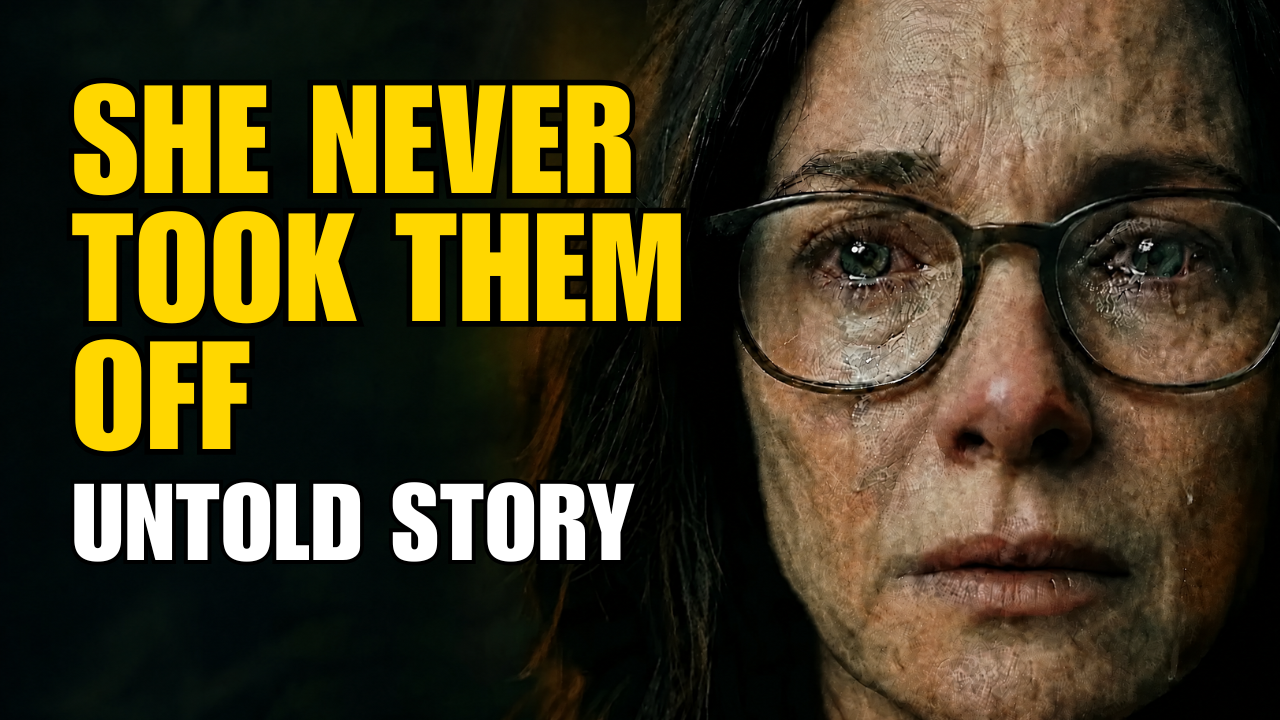
Charlotte and I had been married eight years — together nine. In all that time I had never once seen her without her glasses. Dark-framed, thick, with square lenses. On when she woke up. Off only in the dark, where I couldn't see. By the time she reached our bed they were back on the nightstand in exactly the same position.
I never questioned it. I never suggested she swap them for anything else. I told myself it was just a habit, the way some people need a watch on their wrist. I called that acceptance, and I was quietly proud of it. I thought a good husband was one who let his wife be exactly who she was.
That's the trouble with acceptance that never asks a question. From the inside it feels like love. From the other side it can look a lot like distance. Charlotte never said a word in eight years, and I never gave her a reason to.
It took the contact lens commercial that changed our evening to show me the difference between accepting someone and actually knowing them. The house smelled of shepherd's pie and wet school coats. Charlotte sat in the armchair by the radiator with a book, glasses on, the way she always was, and the children lay sprawled in front of the television.
Why Did Trust Mean Not Pushing Her to Explain?
The children called out again. "Mum, get the new ones. Dad will pay." Charlotte looked up from her book and smiled, and then the smile went thin. "No," she said, very quietly. "That's enough now."
But the children only heard a game. Emma reached up, laughing, toward the frame. Charlotte caught her wrist, not a strike, just a grip, sudden and tight, and Emma pulled free and reached again. Then Charlotte's other hand came down across Emma's cheek. Nine o'clock on a Tuesday night, the television still going.
Emma didn't cry right away. She stood there staring at her mother the way a child stares at something that has broken and shouldn't have. Then she ran into my arms, and James sat silent on the carpet.
I still can't fully explain what I saw in Charlotte's face. It wasn't anger. It was horror, at her own hand. She said, "I need to sleep," and left the room with her back perfectly straight, holding herself together by will alone.
I put both children to bed and told them their mother loved them, that everything would make sense in the morning. James believed me and was asleep in four minutes. Emma held my hand a little longer and didn't ask any more questions.
When I found her she was on the edge of our bed in a dark room, still wearing the glasses, her hands shaking in her lap. I asked her gently what had happened. I told her it was only a game, that nobody had meant any harm. She didn't answer. I could have pushed. Every instinct a husband has says to push, to ask a hundred things at once. I didn't. I waited.
Then she pressed her lips together, as if she were deciding whether the words were even allowed to exist outside her own head. I think trust is built in moments like that, and almost never in the ones we plan. She was about to hand me the heaviest thing she owned, and all it needed from me was to hold still.
"I need to tell you something," she said, so quietly I had to lean in. "These glasses aren't medical. They never were. I don't need them to see. I wear them because I feel like I don't look pretty without them. Because of my nose."
I opened my mouth, and nothing came out. I had a hundred questions: how long she had believed it, why she had never said a word in eight years, why I had never thought to ask. But I could see in her face that this was not the moment for any of them.
And there, finally, was my answer. Why does a person refuse to wear contacts when everyone around her is begging her to try them? Because I understood, at last, that contacts would leave nothing between her face and the world. For eighteen years Charlotte's glasses had stood in front of the one feature she believed was wrong with her. A child's cheerful suggestion, you'll look so pretty without them, had landed like an accusation.
She told me where it began. She was fifteen, at her cousin's wedding in the countryside, in a pink dress she was proud of. In front of the whole family, her own mother said something about her nose. She can still smell that garden, she told me. Cut grass, warm air, the sugar from the wedding cake, and so much laughter. I won't write the rest of the words here.
I have thought many times about the night my wife finally told me why, and about how little she asked of me in return. She didn't need me to fix anything. She needed me to stay in that dark room and not leave.
If you want to hear her tell it in her own words, watch the full story here.
What Does Loving Through Insecurity in Marriage Look Like?
I got up and stood behind her at the window. I didn't give her advice. I didn't try to fix anything. I told her I thought she was the most beautiful woman in the world, and I have never meant anything more. She didn't move. She just stood there, with the streetlight coming through the gap in the curtains.
I didn't say it to fix her. I said it because it was the only true thing I had. I know one sentence from a husband can't undo one sentence from a mother. But I think it can stand beside it, and for a while that was all I could offer.
Here is my confession. I used to think acceptance meant leaving things alone. I now think it means asking, gently, and being ready for the answer. For eight years I mistook my wife's silence for privacy. It was childhood trauma she had been carrying alone since she was fifteen.
I used to wonder why anyone would refuse to wear contacts when the change seems so small. Now I wonder why I never asked what the glasses were protecting her from.
The glasses were never the secret. The secret was how much she was holding, and how quietly she held it. For eight years I stood close enough to touch it, and I kept looking at the frames instead of the woman wearing them. I don't think that makes me a bad husband. I think it makes me one who stopped at the surface, and I'd rather say so plainly.
I think the loudest marriage secrets are rarely the dramatic ones. They're the ones sitting on the nightstand, in exactly the same position, every single night, because we've decided they're ordinary.
I tell real life stories like this on True Life Story Break, because I wish someone had told me one before I needed it.
What Charlotte said to our daughter the next morning, and where the three of us went that afternoon, are in the video. I couldn't write them without my voice, and I don't think they land the same on a page. If you've ever wondered what it looks like when a person finally puts down something she carried for eighteen years, the answer is quieter than you'd expect.
I am William. I am a storyteller. This one is about a husband who thought acceptance meant silence, and a wife who finally let him in. This is True Life Story Break — a true story from every side of life.
If there is a silence in your own marriage — a question you've been afraid to ask — leave it in the comments under the video.
Read more stories on the blog: https://www.truelifestorybreak.com
Watch every story on YouTube: https://www.youtube.com/@TrueLifeStoryBreakA true story from every side of life. 💪